Blood test results explained
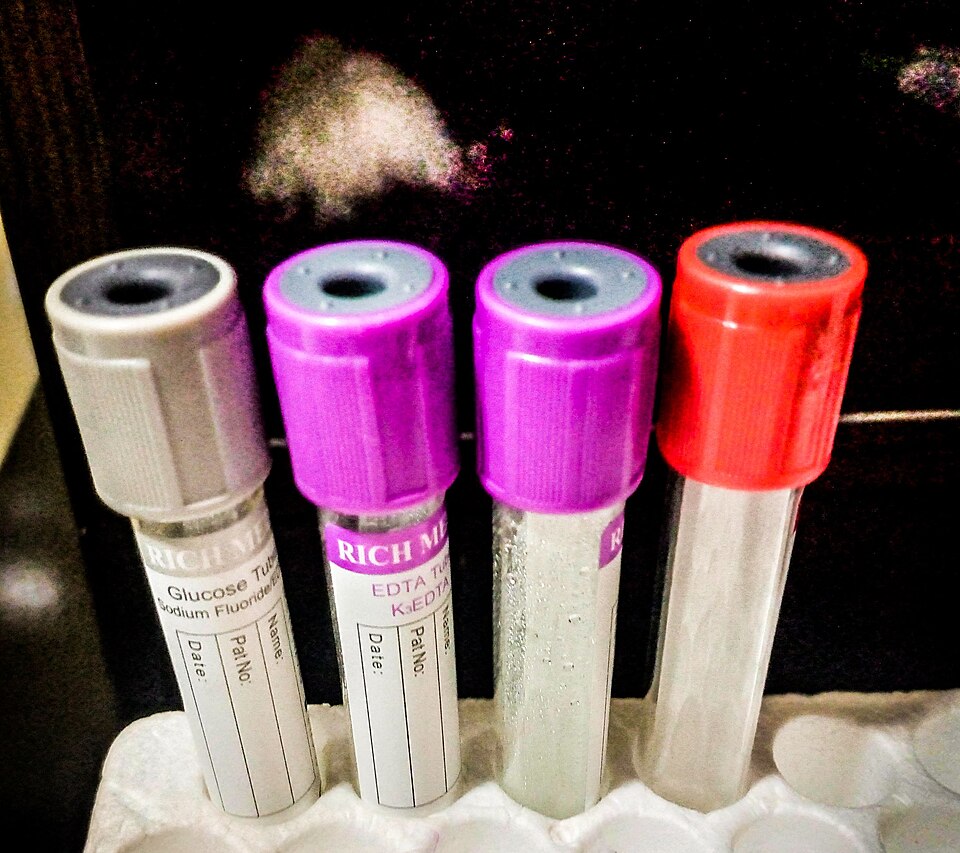
A blood test report normally has five columns, no matter which laboratory produced it: the test name or abbreviation, your result, the unit, the laboratory’s reference range, and sometimes a flag for results outside that range. This page explains the first and third columns: what each test measures and which units you are likely to come across. The table below covers 27 common tests.
Check the unit before the number
Of the 27 tests in our table, 10 are often reported in two different units. Examples include haemoglobin (g/dl or mmol/l), creatinine (mg/dl or µmol/l), blood sugar (mg/dl or mmol/l) and HbA1c (% or mmol/mol). The same blood sample can produce very different numbers depending on the unit used. If you compare results from two laboratories, or look something up online, make sure the units match first.
Groups of tests
Results are usually organised into panels. The names vary between countries:
- Full blood count (German: kleines Blutbild): red and white blood cells, platelets, haemoglobin and the red cell indices MCV, MCH and MCHC.
- Kidney function, urea and electrolytes (Nierenwerte, Elektrolyte): creatinine, eGFR, urea, sodium, potassium.
- Liver function tests (Leberwerte): AST, ALT, GGT, alkaline phosphatase, bilirubin.
- Inflammation markers (Entzündungswerte): CRP.
- Thyroid (Schilddrüsenwerte): TSH.
- Diabetes tests (Blutzucker): glucose, HbA1c.
- Lipid profile (Blutfette): total cholesterol, LDL, HDL, triglycerides.
- Iron studies (Eisenstoffwechsel): ferritin.
Abbreviations differ too. The liver enzyme ALT may appear as ALAT, GPT or SGPT depending on the laboratory and country. All of these are listed in the table. You can also paste a line from your report into the translator, which recognises these abbreviations.
What this page does not do
It does not tell you whether a value is normal, too high or too low for you. Reference ranges depend on the laboratory method, your age and sex, and sometimes on pregnancy or medication. A single value outside the range is not a diagnosis. Your doctor reads the result together with your history and other findings.
| Abbreviation | Name | What it measures | Common units | Source |
|---|---|---|---|---|
| Hb, HGB, Hgb | Haemoglobin | The amount of haemoglobin, the iron-containing protein in red blood cells that carries oxygen around the body. | g/dl, mmol/l | MedlinePlus, DocCheck Flexikon, DocCheck Flexikon |
| Hkt, Hk, HCT, Hct | Haematocrit | The share of the blood volume that is made up of red blood cells. | %, l/l | MedlinePlus, DocCheck Flexikon, DocCheck Flexikon |
| Ery, Erys, RBC | Red blood cell count | The number of red blood cells in a set volume of blood. Red blood cells carry oxygen. | Mio./µl, /pl | MedlinePlus, DocCheck Flexikon, DocCheck Flexikon |
| Leuko, Leukos, WBC | White blood cell count | The number of white blood cells, which are part of the immune system and help fight infections. | /µl, 10^9/l, /nl | MedlinePlus, DocCheck Flexikon, DocCheck Flexikon |
| Thrombo, Thrombos, PLT | Platelet count | The number of platelets, small blood cells that are essential for blood clotting. | /µl, 10^3/µl, 10^9/l | MedlinePlus, DocCheck Flexikon |
| MCV | Mean corpuscular volume | The average size (volume) of the red blood cells. | fl | MedlinePlus, DocCheck Flexikon |
| MCH | Mean corpuscular haemoglobin | The average amount of haemoglobin inside a single red blood cell. | pg, fmol | DocCheck Flexikon, DocCheck Flexikon |
| MCHC | Mean corpuscular haemoglobin concentration | How concentrated the haemoglobin is within the red blood cells on average. | g/dl | DocCheck Flexikon, DocCheck Flexikon |
| Abbreviation | Name | What it measures | Common units | Source |
|---|---|---|---|---|
| CRP | C-reactive protein | A protein made by the liver whose level rises when there is inflammation in the body, for example from an infection. | mg/l, mg/dl | MedlinePlus, DocCheck Flexikon |
| Abbreviation | Name | What it measures | Common units | Source |
|---|---|---|---|---|
| Krea, Crea, Kreat | Creatinine | A waste product from normal muscle activity that is filtered out by the kidneys; used to assess kidney function. | mg/dl, µmol/l | MedlinePlus, DocCheck Flexikon, DocCheck Flexikon |
| eGFR, GFR | Estimated glomerular filtration rate | An estimate of how well the kidneys filter the blood, calculated from creatinine and factors such as age and sex. | ml/min/1,73 m² | MedlinePlus, DocCheck Flexikon |
| Hst, Urea, BUN (US: urea nitrogen) | Urea | A waste product formed when the body breaks down protein; it is removed by the kidneys. | mg/dl | MedlinePlus, DocCheck Flexikon, NHS |
| Na, Na+ | Sodium | Sodium is an electrolyte (a charged mineral) that helps control fluid balance and nerve and muscle function. | mmol/l | MedlinePlus, DocCheck Flexikon |
| K, K+ | Potassium | Potassium is an electrolyte that is important for muscles, nerves and the heart rhythm. | mmol/l | MedlinePlus, DocCheck Flexikon |
| Abbreviation | Name | What it measures | Common units | Source |
|---|---|---|---|---|
| AST, ASAT, GOT, SGOT | Aspartate aminotransferase | An enzyme found mainly in the liver, but also in the heart and muscles; higher blood levels can point to cell damage in these organs. | U/l | MedlinePlus, DocCheck Flexikon |
| ALT, ALAT, GPT, SGPT | Alanine aminotransferase | An enzyme found mainly in the liver; it is used to check for liver damage. | U/l | MedlinePlus, DocCheck Flexikon |
| GGT, γ-GT, Gamma-GT, yGT | Gamma-glutamyl transferase | An enzyme found mostly in the liver; it is used together with other values to look at the liver and bile ducts. | U/l | MedlinePlus, DocCheck Flexikon |
| AP, ALP, aP | Alkaline phosphatase | An enzyme found in many tissues, especially the liver, bile ducts and bones. | U/l | MedlinePlus, DocCheck Flexikon |
| Bili, Gesamtbilirubin, Bili ges. | Bilirubin | A yellowish substance produced when old red blood cells are broken down; the liver normally clears it into bile. | mg/dl, µmol/l | MedlinePlus, DocCheck Flexikon |
| Abbreviation | Name | What it measures | Common units | Source |
|---|---|---|---|---|
| TSH, basales TSH, TSH basal | Thyroid-stimulating hormone | A hormone from the pituitary gland that tells the thyroid gland how much thyroid hormone to make. | µIU/ml | MedlinePlus, DocCheck Flexikon |
| Abbreviation | Name | What it measures | Common units | Source |
|---|---|---|---|---|
| HbA1c, A1c, HbA1 | Glycated haemoglobin (HbA1c) | Shows the average blood sugar level over roughly the past two to three months. | %, mmol/mol | MedlinePlus, DocCheck Flexikon |
| Glc, BZ, Glu, Glucose, Blutzucker | Glucose (blood sugar) | The amount of glucose (sugar) in the blood, the body's main source of energy. | mg/dl, mmol/l | MedlinePlus, DocCheck Flexikon |
| Abbreviation | Name | What it measures | Common units | Source |
|---|---|---|---|---|
| Chol, TC, Cholesterin | Total cholesterol | The total amount of cholesterol, a fat-like substance, carried in the blood in all lipoprotein fractions together. | mg/dl, mmol/l | MedlinePlus, DocCheck Flexikon |
| LDL, LDL-C, LDL-Chol | LDL cholesterol | Cholesterol carried in low-density lipoprotein, often called "bad" cholesterol because too much can build up in artery walls. | mg/dl, mmol/l | MedlinePlus, DocCheck Flexikon |
| HDL, HDL-C, HDL-Chol | HDL cholesterol | Cholesterol carried in high-density lipoprotein, often called "good" cholesterol because it helps remove excess cholesterol. | mg/dl, mmol/l | MedlinePlus, DocCheck Flexikon |
| TG, Trig, TAG | Triglycerides | A type of fat in the blood that the body uses for energy storage. | mg/dl, mmol/l | MedlinePlus, DocCheck Flexikon |
| Abbreviation | Name | What it measures | Common units | Source |
|---|---|---|---|---|
| Ferr, FERR, Serum-Ferritin | Ferritin | A protein that stores iron; its level in the blood reflects how much iron the body has in storage. | µg/l | MedlinePlus, DocCheck Flexikon |
Frequently asked questions
Why does my result have no number range on this page?
Because the right range is the one printed on your own report. Laboratories set ranges for their own methods, and ranges differ by age and sex. We do not publish ranges until we have a source and a medical review for each one.
My report says mmol/l, a website says mg/dl. Which is right?
Both can be right. Several tests are reported in two different units. The numbers are not comparable until they are converted, so always compare a result with the range in the same unit on the same report.
What do H and L mean next to a value?
Many laboratories mark values above or below their reference range, often with H (high) and L (low) or with arrows. The marking only says the value is outside the range. What that means for you is a question for your doctor.
Sources
- MedlinePlus lab tests. U.S. National Library of Medicine (accessed15 October 2026)
- DocCheck Flexikon (units of the individual parameters). DocCheck Medical Services (accessed15 October 2026)